

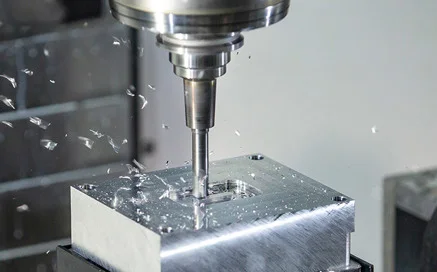

Conventional CNC machining consists of 3‑dimensional processing controlled by side‑side (X), front‑back (Y), and up‑down (Z) movements to remove material from a raw block of plastic or metal material. This type of machining is still very common today and is suitable for most geometries, but milling from only three sides does have its limitations.
At Konlida, our CNC machining services encompass all three approaches—3‑axis, 5‑axis indexed, and 5‑axis continuous—allowing us to select the optimal strategy for each part geometry.
Enter 5‑axis indexed machining (also known as 3+2 machining ). The process uses the same 3‑axis control for the milling process, but the machining table has the ability to rotate in two additional directions. This allows a workpiece to be machined from all sides, which reduces the need for set‑ups and cuts cost. It also improves the capabilities of the CNC machine, allowing for more complex features to be milled.
Now 5‑axis indexed milling is not to be confused with true 5‑axis machining , which allows for continuous machining of all three axes and the two rotational axes. 5‑axis indexed machining does not maintain continuous contact of the cutting tool and workpiece through all rotational axes. It does, however, share many of the same benefits as standard 5‑axis machining, such as:
- Dimensional stability due to fewer set‑ups
- Improved surface finish using shorter tooling
- Lower cycle time to reduce cost
- Greater feature capabilities due to compound angle positioning
For parts requiring extremely fine features or complex free‑form surfaces, true 5‑axis continuous machining may be the best approach. For more on how we apply these capabilities across different industries, see our 5‑axis machining capabilities .
5‑axis indexed machining is perfect for parts that do not require extreme contour controls—such as jigs, fixtures, housings, and other components frequently used in manufacturing. If you need to manufacture a design with extremely fine features, true 5‑axis machining may be best for you.
For more on design considerations for jigs and fixtures, see our designing for jigs and fixtures guide.
With 5‑axis indexed machining at Konlida, you can choose from hard and soft metal materials with maximum dimensions of 99 mm × 74 mm × 66 mm with the added benefit of non‑orthogonal surface machining. If you need larger plastic or metal parts for prototyping or low‑volume runs, we have the availability to produce geometries of 254 mm × 178 mm × 95 mm in ABS, acetal, and aluminium.
For guidance on selecting the right material for your application, see our materials comparison guide .
Which Process Is Right for Your Part?
| Consideration | 3‑Axis | 5‑Axis Indexed (3+2) | 5‑Axis Continuous |
|---|---|---|---|
| Best for | Simple geometries, orthogonal features | Complex parts with multiple sides | Free‑form surfaces, extremely fine features |
| Set‑ups | Multiple (up to 6 sides) | Fewer (part rotates) | Single set‑up |
| Surface finish | Good | Improved (shorter tooling) | Excellent |
| Cost | Lower | Moderate | Higher |
| Complexity | Simple programming | Moderate | Complex programming |
| Typical applications | Brackets, housings, flat parts | Jigs, fixtures, enclosures | Impellers, turbine blades, medical implants |
Can’t decide if 3‑axis or 5‑axis indexed machining is best for you? Do not worry—our automated quoting and toolpathing software selects the optimal process for your part geometry. Upload your CAD model today for a free cost and manufacturability review. In addition to pricing information, the quote includes design analysis, which will identify any difficult‑to‑mill features and even provide an as‑milled view, so you are aware of any remaining material that cannot be removed during the machining processes.
For more on how our quoting and DFM analysis works, see our design for manufacturing toolkit .
Summary
| Process | Key Advantage | Best Application |
|---|---|---|
| 3‑Axis | Simple, cost‑effective | Parts with orthogonal features |
| 5‑Axis Indexed (3+2) | Multiple sides, one set‑up | Jigs, fixtures, housings |
| 5‑Axis Continuous | Complex surfaces, fine features | Impellers, medical implants, aerospace components |
Need Help Choosing the Right Machining Strategy?
Our applications engineering team can help you determine whether 3‑axis, 5‑axis indexed, or continuous 5‑axis machining is the most efficient and cost‑effective approach for your part.