

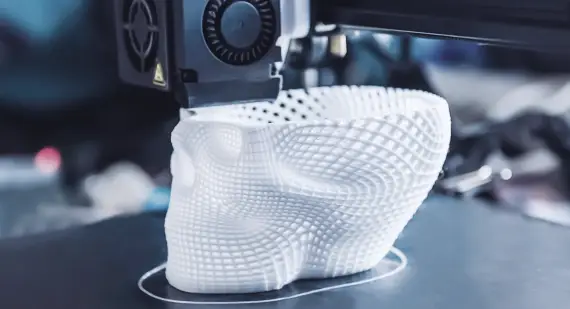

3D‑printed medical tools can often be produced in days instead of weeks, allowing engineers to build parts on demand, refine designs quickly, and move into evaluation faster. That is helping healthcare teams develop more adaptable solutions, with equipment built for a specific patient or procedure.
At Konlida, our 3D printing services support a range of additive technologies for medical applications—from surgical guides and instruments to custom fixtures and device prototypes.
What Are 3D-Printed Medical Tools?
3D‑printed medical tools are instruments, guides, fixtures, and support equipment made with additive manufacturing. That can include surgical instruments, patient‑specific guides, prototypes, and custom hospital equipment.
Engineers designing medical devices often rely on four 3D printing processes: stereolithography (SLA) , selective laser sintering (SLS) , Multi Jet Fusion (MJF) , and direct metal laser sintering (DMLS) . The best fit usually comes down to the application, material requirements, and production goals. That decision is important because medical parts typically need to meet tighter criteria than general prototypes, especially around sterilisation, biocompatibility, and consistent performance.
For teams working in regulated environments, our medical industry solutions provide end‑to‑end support—from prototyping to production—across multiple manufacturing technologies.
Materials for 3D-Printed Medical Tools
Material selection for 3D‑printed medical tools depends on how the part will be used, cleaned, and handled. The processes below cover the most relevant printable options, ranging from durable polymers to high‑strength metals, each with different trade‑offs for biocompatibility, sterilisation tolerance, and structural performance.
| Process | Medically Relevant Materials | Best For | Tolerances |
|---|---|---|---|
| SLA | Polycarbonate, Silicone‑like | Fine detail, smooth surfaces, concept models, guides | ±0.05 mm |
| SLS | Nylon, TPU | Durable plastic parts, complex geometries, functional prototypes | ±0.25 mm |
| MJF | Nylon | Strong plastic parts, repeatable builds, end‑use components | ±0.30 mm |
| DMLS | Titanium, Stainless Steel, Cobalt Chrome | High‑strength metal tools, demanding medical applications | ±0.076 mm |
For guidance on selecting the right material for your medical application, see our materials comparison guide and 3D printing materials guide .
Key Applications for 3D-Printed Medical Tools
3D printing is especially useful for medical tools that need to be customised, produced quickly, or shaped in ways traditional methods cannot easily handle.
Surgical Instruments
During surgery, doctors need instruments that feel steady, precise, and comfortable in their hands. 3D printing helps teams test new geometries faster and create instruments like forceps, clamps, and retractors that are tailored to a specific procedure or surgeon’s preference.
Patient‑Specific Surgical Guides
No two patients are exactly alike, and 3D printing makes it easier to produce custom guides that support more precise placement, alignment, and surgical approach.
For more on how 3D printing enables patient‑specific solutions, see our 3D printing in medical implants guide .
Custom Fixtures and Hospital Equipment
3D printing can help hospitals, labs, and medical device teams quickly manufacture small functional parts that are too specialised for mass production, such as holders, positioning aids, test fixtures, or replacement components.
For more on the difference between tools and fixtures, see our jigs and fixtures guide .
Why Use 3D Printing for These Applications?
3D printing gives teams more room to solve the actual problem instead of designing around manufacturing constraints. Here is where 3D‑printed medical tools often deliver the most value:
- Design freedom: Internal channels, ergonomic curves, and other complex shapes can come out of a single build instead of requiring difficult machining or moulds.
- Per‑patient customisation: 3D printing makes it easier to create custom guides and other tools that directly match a patient’s anatomical needs.
- Fast production without tooling or moulds: Parts can move from CAD file to finished tool in a matter of days—essential when a surgery is scheduled or a validation run is holding up a launch.
- Improved ergonomics: Small changes to grip, balance, or weight can make medical tools easier to control during long or delicate procedures.
For a broader view of how digital manufacturing accelerates product development, see our rapid prototyping guide .
Emerging and Future Opportunities
Medical tool development is changing fast, and 3D printing is helping drive the innovations.
Digital Surgical Planning
CT‑to‑CAD‑to‑print workflows are making it easier to turn patient imaging into anatomy‑specific cutting guides, drill guides, and procedure planning models before a surgery even begins.
Advanced Metal Printing
Better metal printing and post‑processing are facilitating lighter tools, more intricate geometries, and stronger custom components. Similar advances are also showing up in implants such as porous titanium structures that can support bone ingrowth over time.
For more on metal 3D printing capabilities, see our DMLS guide and titanium vs. aluminium guide .
Distributed Manufacturing
On‑demand printing brings specialised medical tools within reach of healthcare settings that previously could not access them.
Challenges and Considerations of 3D Printing in Healthcare
3D printing is powerful, but engineers still need to plan around the realities of medical manufacturing.
Regulatory Requirements
Medical applications may require strict documentation, validation, and compliance planning. For more on quality management in medical manufacturing, see our ISO certifications and quality standards and why your parts supplier should be ISO 9001 certified .
Material Limitations
Not every printable material is suitable for sterilisation, skin contact, or demanding clinical use. For high‑temperature or implant‑grade needs, parts may need to be machined or moulded rather than printed.
Quality Control
Production use depends on documented process parameters, post‑processing validation, and inspection workflows that hold across every build—particularly for regulated devices.
Production Economics
3D printing is great for low volumes and high‑mix runs, but once quantities reach thousands of identical parts, injection moulding or CNC machining often have lower per‑unit costs.
For a comparison of additive vs. subtractive manufacturing approaches, see our MJF vs. FDM guide .
The Bigger Impact
3D‑printed medical tools are giving teams a faster, more flexible way to develop equipment for specific procedures, patients, and clinical needs.
In both advanced and resource‑limited healthcare settings, that agility opens the door to an ever‑expanding range of practical, patient‑centred solutions.
Summary
| Application | Key Benefit | Recommended Process |
|---|---|---|
| Surgical instruments | Ergonomic customisation, fast iteration | SLA, DMLS |
| Patient‑specific guides | Anatomical fit, precision | SLA, SLS |
| Custom fixtures | Low‑volume, specialised geometries | SLS, MJF |
| Metal tools | Strength, sterilisability | DMLS |
| Functional prototypes | Design validation, handling tests | SLS, MJF |
Ready to Explore 3D Printing for Medical Applications?
Konlida’s 3D printing services support a wide range of medical and healthcare applications—from surgical guides and instruments to custom fixtures and device prototypes.