

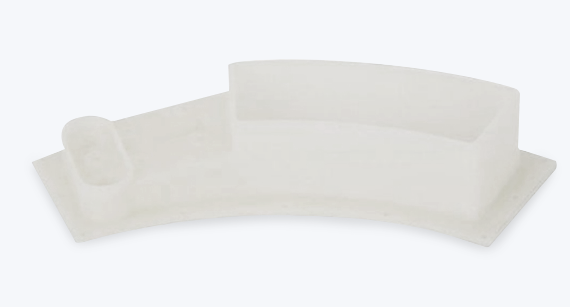

We sometimes get questions about how thermoplastic elastomers (TPEs) differ from thermoset elastomers and which of the various TPEs would work best for a given part. One of the most fundamental differences between a part made with thermoplastics and one made with thermosets has to do with the chemistry that happens when the part is formed.
For a broader comparison of material families, see our thermoplastic vs. thermoset injection moulding guide .
What is Thermoplastic Rubber?
Thermoplastic rubber (TPR), often used interchangeably with thermoplastic elastomer (TPE), is a class of materials that combines the flexibility and elasticity of rubber with the processing advantages of plastics. In practical terms, it behaves like rubber under use (stretching and returning to shape) but can be melted, moulded, and reformed like a thermoplastic. This dual nature makes it especially useful in injection moulding , where materials need to flow easily into moulds and solidify quickly into durable, flexible parts.
Unlike traditional rubber, which undergoes irreversible chemical curing, thermoplastic rubber softens when heated and hardens again when cooled. This means it can be reprocessed, reshaped, and even recycled—offering advantages in speed, cost, and sustainability for manufacturing. Because of this versatility, thermoplastic rubber is widely used in applications like seals, grips, overmoulded components , and flexible housings where both durability and a soft‑touch feel are important.
Types of Thermoplastic Elastomers
You can break TPEs into six primary categories that differ based on their chemical composition and structure:
- TPV – Thermoplastic vulcanisates
- TPU – Thermoplastic urethanes
- TPO – Thermoplastic olefins
- SBC – Styrenic block copolymers
- COPE – Copolyester elastomer
- PEBA – Polyether block amide
There can be substantial differences between each type of TPE and even the formulation of each subtype, so it is important to pick the right material when considering part longevity and cost.
| TPE Type | Trade Names | Chemical Resistance | Dimensional Stability | Density | High Tensile Strength? | Shore Hardness Range | Continuous Use Temp. Limit |
|---|---|---|---|---|---|---|---|
| TPV | Geolast, Santoprene, Sarlink | good | good | high | moderate | 40A to 50D | 135°C |
| TPU | Texin, Elastollan, Desmopan | excellent (polyester-based) | good (with additives) | high | yes | 65A to 80D | 120°C |
| TPO | Polytrope, Hostacom, Thermorun | good | good | low | yes | 75A to 80D | 120°C |
| SBC | K‑Resin, Kraton, Asaflex | limited | good | low | low‑to‑moderate | 15A to 50D | 110°C |
| COPE | Hytrel, Pibiflex, Heraflex | good | good | high | yes | 90A to 80D | 140°C |
| PEBA | Vestamid, Pebax | good | good | low | yes | 80A to 75D | 170°C |
TPV – Thermoplastic Vulcanisates
This is a hard thermoplastic material with regions of softer cross‑linked rubber dispersed throughout its polymer matrix. In general, it offers a “soft” feel, matte finish, and high compression set. Be aware that it is not available in clear.
Applications: Seals, boots and grommets, bumpers, under‑hood applications
For automotive applications requiring TPV, see our automotive industry solutions .
TPU – Thermoplastic Urethanes
This is a block copolymer with alternating hard and soft regions on its molecular backbone, containing urethane linkages. TPU is noted for its mid‑to‑high hardness, good clarity, moderate compression set, and good wear, abrasion, and tear resistance. It is suitable for outdoor applications and must be dried prior to moulding. It is also rather expensive. TPU is distinguished as the only TPE available for 3D printing.
Applications: Protective cases, sporting equipment, medical equipment, footwear, in‑line skate wheels
For more on TPU in additive manufacturing, see our benefits of TPU in elastomeric part designs guide.
TPO – Thermoplastic Olefins
This is a “hard” polyolefin (typically polypropylene) blended with “soft” non‑crosslinked rubber regions. Its high hardness yields a tough product with high impact strength. Some grades are weather‑resistant. It has a low compression set and, unlike TPU, is comparatively inexpensive.
Applications: Automotive interior: dashboards, bumpers, roofing
SBC – Styrenic Block Copolymers
These plastics are made up of hard styrene regions and “soft” elastomeric regions arranged in alternating blocks, typically mixed with a more rigid polymer such as polypropylene. There are many different SBCs, so properties are often dependent on specific formulation. SBC is the softest and most flexible of all TPEs. It has a glossy surface, high elongation, good transparency, and good abrasion resistance.
Applications: Soft‑touch handles, buttons, knobs, grips; gel inserts
COPE – Copolyester Elastomer
COPE is a copolymer consisting of hard crystalline polyester regions and soft amorphous segments. It is noted for its high temperature resistance, tear strength, and impact strength. It also has good creep resistance and low moisture absorption.
Applications: Furniture, auto boots, bumpers, prosthetics
PEBA – Polyether Block Amide
This copolymer consists of hard polyamide blocks alternating with soft elastomeric blocks. PEBA is noted for its good flex fatigue, creep, and impact resistances. It also does well in high temperatures and has a low compression set.
Applications: Medical equipment, sports equipment, electronics
For medical applications of TPEs and other elastomers, see our medical industry solutions and common impact‑resistant plastics guide .
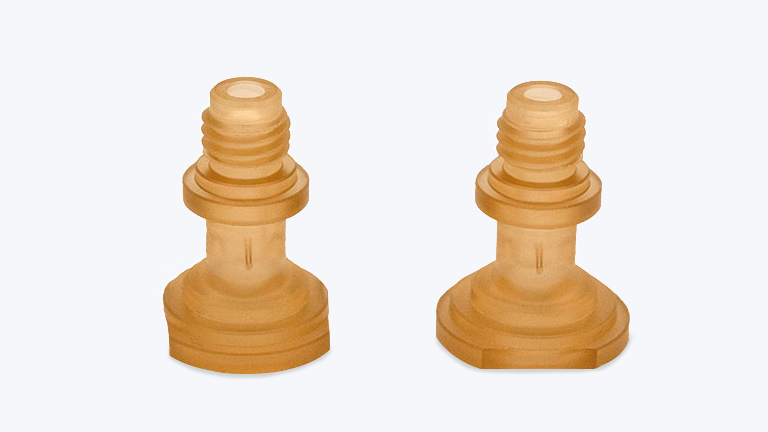
Applications of Thermoplastic Elastomers
Thermoplastic elastomers are widely used in prototypes and end‑use parts due to their flexibility, durability, and ease of processing. Common applications include:
- Soft‑touch grips for consumer electronics and tools
- Automotive seals and gaskets
- Medical device components such as tubing and wearable parts
- Overmoulded features that improve ergonomics and waterproofing
- IoT devices, packaging, and sporting goods where a combination of elasticity and thermoplastic processability is essential
For guidance on designing parts with TPEs, see our overmoulding and insert moulding design guide and designing effective clips guide —many clip and snap‑fit designs benefit from TPE’s flexibility.
TPE vs. Thermoset Elastomers
| Property | TPE (Thermoplastic) | Thermoset Elastomer (e.g., LSR) |
|---|---|---|
| Processability | Meltable, reprocessable | Irreversible curing |
| Recyclability | Yes | No |
| Cycle time | Faster | Slower (curing time) |
| Temperature resistance | Moderate (110–170°C continuous) | Excellent (up to 300°C+) |
| Compression set | Moderate to good | Excellent (very low) |
| Cost | Generally lower | Higher |
| Typical applications | Consumer goods, grips, seals | Medical implants, high‑temp seals |
For more on thermoset elastomers, see our LSR moulding guide and optical liquid silicone rubber guide .
Summary
| TPE Type | Best For | Key Advantage |
|---|---|---|
| TPV | Seals, gaskets, under‑hood | Soft feel, matte finish |
| TPU | Protective cases, medical, footwear | Wear resistance, clarity |
| TPO | Automotive interior, bumpers | High impact strength, low cost |
| SBC | Soft‑touch grips, handles | Softest, most flexible |
| COPE | Furniture, prosthetics | High temperature, tear strength |
| PEBA | Medical, sports, electronics | Flex fatigue resistance |
Ready to Start Your TPE Project?
Konlida supports a wide range of TPE materials for injection moulding and overmoulding applications—from soft‑touch consumer products to durable automotive components.