





Custom CNC Milling Services for Precision Parts
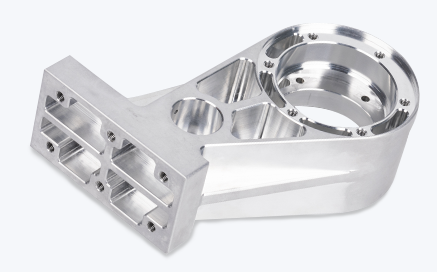
Complex geometries, contoured surfaces, and precision pockets—machined in a single setup with 3-axis and 5-axis CNC milling. Ideal for housings, brackets, medical devices, and aerospace components. Prototypes in 5-7 days. Global shipping.
Certifications ISO 9001:2015 | ISO 13485:2016 | AS9100D | IATF 16949
Innovative Companies We Support
Jump to Section
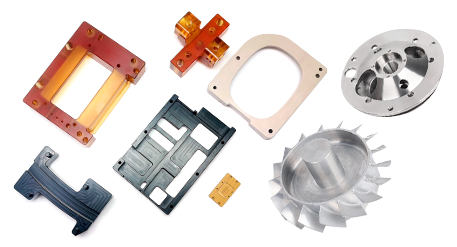
Konlida's CNC milling service combines advanced 3-axis and 5-axis machining with ISO-certified quality systems to deliver custom precision parts. From functional prototypes to low-volume production runs, we machine complex geometries in aluminum, stainless steel, titanium, and engineering plastics—all with tolerances down to ±0.002mm and full material traceability.
Finishing options include anodizing, passivation, and bead blasting. Common applications span medical devices, aerospace brackets, automotive housings, and industrial tooling.
CNC Machining Design Guide
In this guide to CNC machining, you'll learn how to create efficient, manufacturable metal and plastic parts for prototyping and production.
CNC Milling Design Guidelines and Capabilities
Our basic guidelines for CNC milling include important design considerations to help improve part manufacturability, enhance cosmetic appearance, and reduce overall production time. View our design guidelines page for more details.
Maximum Dimensions
Maximum depth that can be milled is 2 in. (50.8mm) from either side of part. For specific milling dimensions by material, see maximum part extents for machining.
| Material | US | Metric | |
| 3-axis** |
| 10 in. x 14 in. x 1.75 in. | 254mm x 356mm x 44.5mm |
| 3-axis** |
| 22 in. x 14 in. x 0.75 in. | 559mm x 356mm x 19.1mm |
| 3-axis** |
| 22 in. x 14 in. x 3.75 in. | 559mm x 356mm x 95.3mm |
| 5-axis |
| 10 in. x 7 in. x 1.75 in. | 254mm x 178mm x 44.45mm |
| 5-axis |
| 10 in. x 7 in. x 3.75 in. | 254mm x 178mm x 95.3mm |
| 5-axis |
| 4.25 in. x 3.25 in. x 3.75 in. | 107.95mm x 82.55mm x 95.25mm |
*Hard metals: Titanium (6Al-4V), Stainless Steels (303, 316, 17-4PH), Steel Alloy (4140)
**Denotes two-sided machining only
Minimum Dimensions
| US | Metric | |
| Size | 0.25 in. x 0.25 in | 6.35mm x 6.35mm |
| Nominal Thickness | 0.040 in. | 1.02mm |
Threading
In the Konlida automated factory, we currently support UNC and UNF threads from #2 up to 0.5 in., and metric threads from M2 to M12. Avoid modeling internal threads on your part design.
Tolerances
Standard Tolerances
For parts that don’t require a technical drawing we typically can hold a machining tolerance of +/- 0.005 in. (0.13mm). Part features are recommended to be thicker than 0.020 in. (0.51mm) in all regions and a nominal part thickness above 0.040 in.
High-Requirement Tolerances
For additional tolerance requirements, we require a technical drawing at time of upload. Linear tolerance quoted to ISO 2768-1-1989-f, standard hole tolerance of +/- 0.005 in. (0.13mm) and hole and bore-style tolerance on specified features may be +/- 0.0005 in. (0.01mm).
Radii
Sharp inside corners on a part will be radiused (rounded) as a natural result of the CNC machining process. Resulting radii will be the minimum allowable tool radius.
Text
Konlida’s fully automated factory allows you to design in engraving. We allow:
- Plastic and soft metals: Minimum width of 0.018 in. (0.457mm), depth of 0.0118 in. (0.3mm). Example text size would be 16 point Arial Rounded MT font.
- Hard metals: Minimum width of 0.033 in. (0.838mm) and depth of 0.0118 in. (0.3mm). Example text size would be 22 point Arial Rounded MT font.
- If design permits it, opt for recessed text versus raised
Konlida also offers Laser Part Marking and Ink Stamp for our semi-automated factory capability as well as via Konlida Network website.
| Ink Stamp | Spec |
|---|---|
| Black Ink | MIL-A-A-208, 13pt. (1/8") Characters |
| Black Epoxy Ink | MIL-A-56032, 13pt. (1/8") Characters |
| White Ink | MIL-A-A-208, 13pt. (1/8") Characters |
| White Epoxy Ink | MIL-A-56032, 13pt. (1/8") Characters |
CNC Machining Services for End-Use Parts
Get high‑quality machined parts faster with our expanded automated CNC milling—parts ready in as fast as 4 days
CNC Milling Materials
We stock more than 30 production-grade plastic and metal materials that are suitable for various part applications and industries.
- PMMA
- Polycarbonate
- Polypropylene
- POM (Delrin)
- PPSU
- HIPS
- PTFE
- PVC
Metals
- Aluminum
- Brass
- Copper
- Stainless Steel
- Steel Alloy
- Steel Mild Low Carbon
- Titanium
Evaluate standard surface finishes for CNC machined parts as well as advanced capabilities to improve durability, surface finish, and add color.
Surface Finish on Milled Parts
Typically, we break (debur) the edges on all machined parts. All machined plastic parts are left as-machined, which may leave visible tool marks. Some metal parts, on the other hand, allow more choice. Parts left with sharp edges should be handled with care.

Material: ABS Black
Finish: Broken edge

Material: ABS Natural
Finish: Broken edge

Material: Aluminum
Finish: Broken edge

Material: Aluminum
Finish: Bead Blast

Material: Aluminum
Finish: Sharp Edge
Tour our Digital Machine Shop
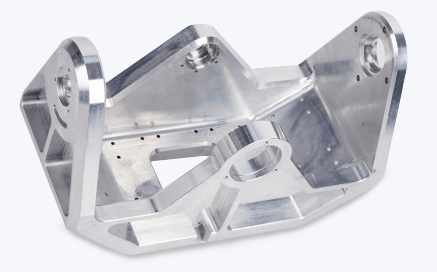
Step inside Konlida's 45,000 ㎡ manufacturing floor in Suzhou, China. See our DMG MORI and Mazak 5-axis milling centers in action, explore the Hexagon CMM quality lab, and view ISO 13485 cleanroom assembly—all operating under one AS9100D certified quality system.
What is CNC Milling and How Does it Work?
CNC milling is a subtractive manufacturing process that uses rotating cutting tools to remove material from a solid workpiece. The process begins by securing a block of metal or engineering plastic inside the CNC mill. Guided by G-code generated from a 3D CAD model, the machine rapidly mills out precise features, pockets, slots, and contoured surfaces.
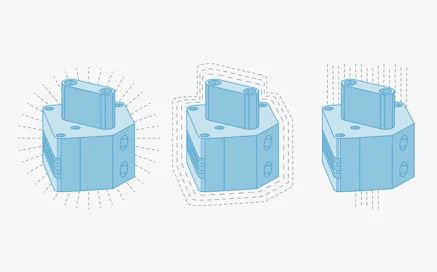
CNC milling machines operate on multiple axes. 3-axis mills move the cutting tool along X, Y, and Z linear axes, suitable for prismatic parts and flat surfaces. 5-axis mills add two rotational axes, enabling complex geometries and undercuts to be machined in a single setup.
Machined plastic parts are typically left as-milled, showing visible tool marks. Metal parts may undergo additional finishing processes such as anodizing, passivation, or bead blasting to enhance surface properties or appearance. Once machining and finishing are complete, parts are inspected and prepared for shipment.
Resources
Plating and Other Finishing Options forCNC Machining, Sheet Metal
Check out these machining and sheet metal finishingoptions to protect parts and improve function.
6 Ways to Optimize Part Design for CNCMachining
Consider hole depths, threading, wall thickness, andmore to reduce production time and expense.
How to Design Efficient Parts for CNCMachining
Learn a number of ways to modify your CNCmachining design to not only improve functionality,but reduce manufacturing costs.
CNC Machining Sample Quote
View a CNC machining sample quote to exploreProtoQuote's design for manufacturability feedbackand real-time pricing capabilities.