



With a wide range of metals and plastics, keep functionality in mind when choosing materials for machined parts
Choice is good. In most cases, the more options you have, the better your chances of getting exactly what you need. But with more choices, finding the perfect fit becomes more complicated.
This dilemma is certainly true in product design and development – especially when selecting materials for CNC machined parts. Material options abound. Your design is custom, and you know your requirements better than anyone else. To help you navigate this “over‑choice” challenge, here are several practical ways to use your knowledge of your part’s function or application to narrow down material options, simplify your search, and achieve the best possible result:
- Determine the required properties for your part’s function
- Identify commonly used materials for machined parts
- Consider related secondary processes (finishing, threading, etc.)
- Use machined prototypes to validate material choices
Prioritising Your Part’s Requirements
The first step is to prioritise your requirements. Start with the “must‑haves” and work down to the “nice‑to‑haves”. This process will usually reduce your material options to a manageable number and help you make a more informed choice.
At Konlida Precision Technology, we use advanced software to evaluate your CAD design and generate a quote, but we cannot know your specific application. You know the conditions in which your part will operate and how it fits into an assembly. That information is key. The following factors should be considered when setting your priorities:
Environmental
For many applications, this is an absolute top requirement. Consider heat and cold resistance, flame retardancy, UV stability, and chemical tolerance. Depending on the use case, materials may need to be food‑grade or medical‑grade. For example, parts for medical devices may have to withstand repeated autoclave (high heat) or aggressive chemical sterilisation.
Electrical
Parts may need to conduct electricity, act as an insulator, or dissipate static charge. Selecting the correct metal or plastic resin is critical for these requirements.
Mechanical
Strength comes in many forms. A part may need to be rigid or flexible, require high tensile or compressive strength, resist impact, or provide wear resistance and lubricity bearings (→ /applications/bearings/). Various materials meet these needs – some more effectively than others.
Cosmetic
In many cases, appearance is secondary; in others, it is essential. Some materials (especially plastics) can be transparent or translucent, and they can be supplied in various colours. Metals can be coloured using secondary processes such as anodising. Surface texture – from non‑slip to high polish – can also be specified.
Size
While machining can produce parts across a wide range of sizes, the maximum available dimensions of a particular stock material may limit the part size. Konlida supports larger machined part sizes for aluminium 6061 and 7075, with maximum dimensions up to 609 mm × 406 mm × 102 mm (larger sizes available via our partner network(→ /network/).
Cost
Cost is often an important factor, typically placed among the “nice‑to‑haves” after the essential requirements have been met.
Commonly Used Machining Materials
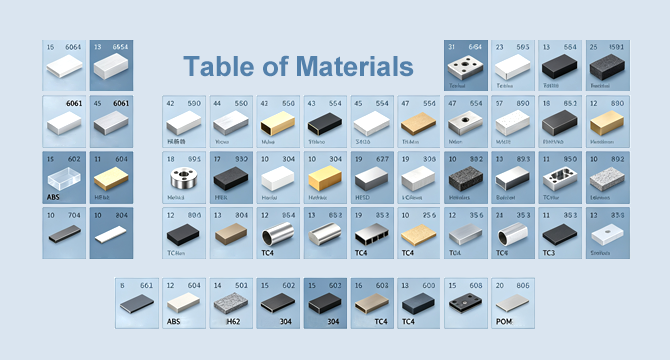
Over the years, our engineers have identified a selection of materials that work well for CNC machining and are popular among customers. For metals, these include aluminium, brass, copper, stainless steel, and various steel alloys. For plastics, designers frequently choose PEEK, ABS, acetal (POM), nylon, polycarbonate (PC), PVC, HDPE, LDPE, and more.
Konlida offers more than 40 different grades of plastic and metal materials. Below are some important characteristics of the most popular machining materials:
ABS vs. Acetal (POM)
- ABS – High impact strength, low heat conductivity, low coefficient of friction.
- Acetal (POM) – High mechanical strength, good dimensional stability, low moisture absorption.
PEEK vs. Ultem (PEI)
- PEEK – High abrasion and wear resistance, low moisture absorption, low coefficient of friction.
- Ultem (PEI) – Extreme strength and stiffness, chemical resistance, high dielectric strength.
Aluminium 6061 vs. 7075
- 6061 – Excellent machinability, low cost, versatility.
- 7075 – High strength and hardness, low weight, good heat tolerance.
Finishing Options and Secondary Processes
Beyond material selection, you should also consider related secondary processes. For example, if you choose an aluminium alloy (6061 or 7075), two common surface treatments are available:
- <span style="background-color: #d4edda;">Anodising</span> – Preferred for durability and wear resistance. (→
/services/finishing/#anodizing) - <span style="background-color: #fff3cd;">Chromate conversion coating</span> – Better for cosmetic appearance and maintaining electrical conductivity. (→
/services/finishing/#chromate)
If your design includes <span style="background-color: #d4edda;">threaded features</span>, you have several options: (→ /resources/threading-guide/)
- Machined‑in threads – Sufficient and economical when stress and wear are minimal.
- Replaceable inserts – Coil inserts or key inserts extend part life under higher stress. Key inserts are recommended for the most demanding threaded applications.
The final choice is the actual machining process – <span style="background-color: #d4edda;">3‑axis, 5‑axis, or turning</span> – which is typically driven by part geometry. (→ /services/cnc-machining/#capabilities)
Larger Metal Parts
Konlida supports larger machined part sizes for aluminium 6061 and 7075:
- Maximum standard size: 559 mm × 356 mm × 95 mm
- Increased block size (upon request): 609 mm × 406 mm × 102 mm
- Maximum diameter for turned parts: 100 mm
Larger sizes and extended capabilities (e.g. <span style="background-color: #fff3cd;">wire EDM, grinding, boring</span>) are also available through our <span style="background-color: #fff3cd;">partner network</span>. (→ /network/)
Using Machined Prototypes to Validate Material Choice
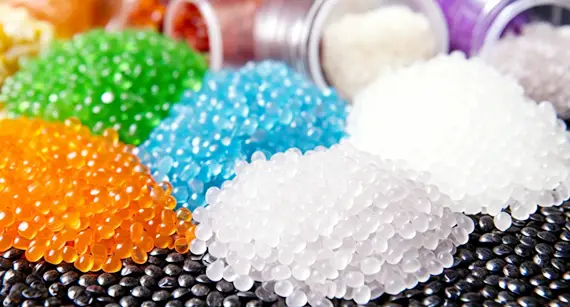
Machining is often used for end‑use production parts – for example, a small number of <span style=”background-color: #d4edda;”>jigs</span> or a <span style=”background-color: #fff3cd;”>low‑volume production run</span> (→ /services/cnc-machining/#low-volume). It is also frequently used to produce prototypes that will eventually be manufactured in much higher volumes by processes such as <span style=”background-color: #d4edda;”>injection moulding</span> (→ /services/injection-molding/). In such cases, you can save money by machining initial prototypes rather than moulding them. When doing so, choose machinable materials that are as close as possible (ideally identical) to those intended for final production.
For instance, many popular injection moulding resins – <span style=”background-color: #d4edda;”>ABS, acetal (POM), PEEK, and Ultem (PEI)</span> – are also available in block form for machining. (→ /materials/plastics/)
Final Thoughts
Having a wide range of material choices is preferable to facing limitations. To help you further, Konlida’s <span style=”background-color: #d4edda;”>application engineering team</span> is available to answer your questions about material selection, design for manufacturability, and cost optimisation. (→ /contact-us/)
Ready to start your next CNC machining project?
Simply upload your <span style=”background-color: #d4edda;”>3D CAD file</span> to our website. Within hours, you will receive a detailed manufacturing analysis and a competitive quote tailored to your requirements. (→ /quote/)