

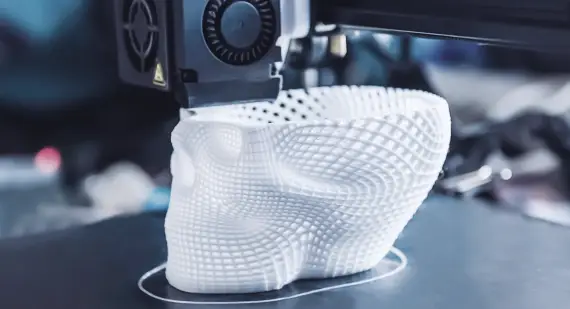

How does stereolithography and its several variants stack up against other polymer-based prototyping options?
Many people in the manufacturing industry associate the term “rapid prototyping” with the invention of stereolithography (SLA). First commercialised in 1986, this resin‑based printing process soon became a favourite of product developers looking for fast and accurate 3D models of their designs.
Competing technologies quickly followed using a variety of materials, including non‑resins. Today, designers have a wide range of rapid prototyping options at their disposal. Popular non‑resin 3D printing technologies include fused deposition modelling (FDM), selective laser sintering (SLS), and Multi Jet Fusion (MJF), as well as several newer SLA variants. The question then becomes: Which one is best for my application?
What is Resin 3D Printing?
Resin 3D printing is an umbrella term used to describe additive manufacturing technologies that build parts from a liquid photopolymer resin that hardens (“cures”) when exposed to a light source.
Filament‑based printers like FDM melt a spool of plastic filament feedstock to create parts layer‑by‑layer, while powder‑based printers (SLS and MJF) fuse powder particles using a laser, fusing agents, or other heat sources.
All resin‑based processes share some common attributes. Chief among them are higher resolution and finer part details compared to filament or powder printers, with less of the “stair‑stepping” common to 3D printing. This is due to precise control of the light source and the ability to generate thinner layers, leaving smoother finishes. In addition, resin parts often require less post‑processing than those made via other methods, reducing cost and improving accuracy.
Because of this, resin‑based 3D printing is often the preferred method for:
- Parts with intricate designs
- Small or miniature parts
- Components with fine features
Some typical prototype and low‑volume use cases for stereolithography include:
- Patient‑specific surgical guides [Internal Link: /industries/medical/]
- Dental aligners
- Jewellery moulds and patterns
- Knobs and covers for automotive use [Internal Link: /industries/automotive/]
- Electronic housings [Internal Link: /applications/enclosures/]
How Do Different Resin 3D Printers Work?
Here is a brief outline of the available technologies, followed by key considerations for each.
Stereolithography (SLA)
The grandfather of additive manufacturing, SLA has continued to evolve. Today’s machines are much faster and more accurate than their predecessors. All rely on an ultraviolet (UV) laser to trace the outline and interior of each layer, curing the liquid resin as it goes. Once each “slice” is complete, the build platform drops slightly, fresh resin is drawn across the cured surface, and the process repeats until the build is complete. Very fine detail is possible, albeit at lower speeds than some newer resin processes.
Carbon DLS (Digital Light Synthesis) / similar technologies
Where the laser in an SLA printer traces every detail layer‑by‑layer, DLS technology uses a digital light projector to flash entire cross‑sectional images onto the resin, curing whole layers almost instantly. This results in significantly faster build rates with virtually no stair‑stepping. Konlida offers DLS‑equivalent capabilities for high‑throughput resin printing. [Internal Link: /services/3d-printing/dls/]
PolyJet
Imagine an inkjet printer that deposits liquid photopolymer resin onto a build tray; after each layer, a UV light passes overhead, curing the resin. PolyJet is one of the few AM technologies that supports multiple material types in a single build, including a wax‑like support material that is washed away after printing. This allows designers to create prototypes that combine two colours or durometers (hardness) — ideal for flexible parts like gaskets and seals. [Internal Link: /services/3d-printing/polyjet/]
Materials Used in Resin 3D Printing
Resin printers can process a wide variety of photopolymers, enabling diverse applications. Among them are:
- Soft, silicone‑like materials
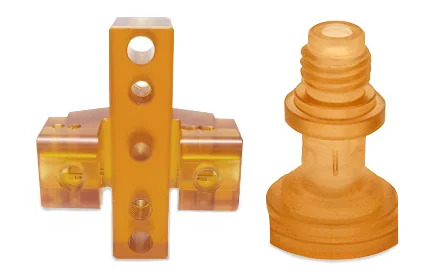
- Hard, heat‑resistant resins (similar to ceramic after curing)
- General‑purpose resins mimicking ABS or polypropylene (PP)
- Polycarbonate‑like resins that produce clear or translucent parts with high stiffness
By comparison, non‑resin SLS and MJF printers are mainly limited to nylon and PP, while FDM can print various thermoplastics but at much lower accuracy and speed.
Important: Resins require careful storage — typically away from light and at controlled temperatures. They contain volatile organic compounds (VOCs) and must be used in well‑ventilated areas; skin contact should be avoided.
Resins are generally more expensive than filament or powder and are often proprietary to the printer manufacturer. However, given the variety of available materials and their robust mechanical properties, the cost difference is often secondary to product performance.
For a full list of materials supported by Konlida, visit our [Material Selection Guide [Internal Link: /materials/]].
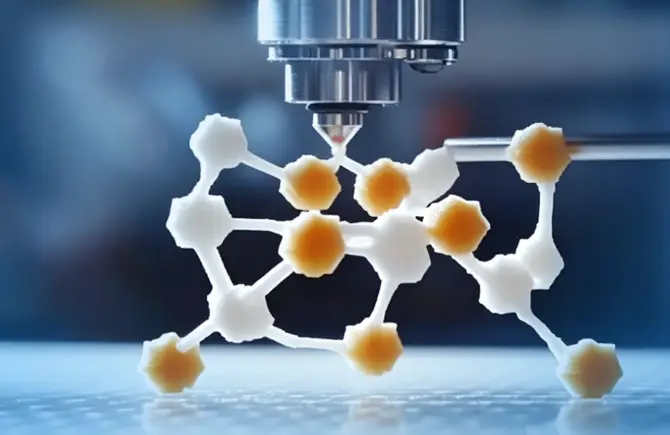
Comparing Industrial and Desktop Resin 3D Printers
Some might look at the relatively low cost of desktop printers and wonder: Why not buy our own machine? That is possible, but industrial‑grade printers typically provide:
- Higher precision and smoother surface finishes
- Significantly greater speed and larger build volumes
- A more comprehensive material selection
For functional testing, getting as close as possible to the end‑use material is critical. Industrial printers also offer professional post‑processing and quality control that desktop machines cannot match.
Perhaps the biggest reason to “go industrial” is experience. Successful resin 3D printing requires deep expertise in orientation, support generation, and post‑processing — not just equipment.
Konlida’s 3D printing team has helped numerous customers bring complex designs to life, including:
- A Braille learning device requiring features as small as 0.05 mm
- Miniature components for a medical hysteroscopy system, saving over €230,000 in tooling costs and cutting months from development time
These examples illustrate that outsourcing to an experienced industrial partner often yields better quality, lower total cost, and faster time‑to‑market than in‑house experimentation.
Outsourced vs. In‑house 3D Printing: Comparison
| Advantages | Disadvantages | |
|---|---|---|
| Outsourced (Konlida) | More processes and materials; greater capacity; professional DFM support | Slightly longer lead time (but offset by expertise) |
| In‑house | Convenience; no quoting wait; fastest iteration | Lower quality/accuracy; limited materials; upfront investment; environmental and safety concerns |
Post‑Processing for Resin 3D Prints
Resin‑based 3D printing technologies share the need for build supports, which must be removed after printing. Support removal methods vary:
- PolyJet: Simply wash away the wax‑like support.
- SLA / DLS: Break away supports and sand the remaining nubs.
Other post‑processing options include:
- Vapour smoothing
- Dyeing (colouring)
- Decals, painting, and texturing
- Additional thermal curing (for DLS parts)
Konlida offers a full range of finishing services for resin‑printed parts. [Internal Link: /services/finishing/]
Final Thoughts
Each resin‑based 3D printing process delivers high‑quality parts with fine details and superior accuracy. The decision as to which technology is most appropriate for your application depends on part size, quantity, material availability, and mechanical requirements.
Konlida’s 3D printing application engineers are ready to help you select the right process and material for your project — from rapid prototypes to low‑volume production parts.