



How to Design for CNC Turning
A practical guide to optimising cylindrical parts for lathe machining
Designing parts specifically for CNC turning requires a different mindset than designing for milling. While the two processes share some common principles, turning introduces unique considerations – from part geometry and wall thickness to tool access and workholding.
This guide outlines the key design considerations for parts intended for CNC turning on Konlida’s live‑tool lathes. Following these guidelines will help you reduce cycle time, minimise tool wear, and lower overall production costs.
1. Part Geometry – The Basics
Parts suitable for turning are generally rotationally symmetric – meaning they have a consistent cross‑section around a central axis.
Ideal Candidates for Turning
- Shafts and axles
- Pistons and cylinders
- Fittings and connectors
- Bushings and sleeves
- Pulleys and rollers
- Threaded components (bolts, studs, nuts)
Characteristics That Favour Turning
| Feature | Why It Works Well on a Lathe |
|---|---|
| Cylindrical external surfaces | Natural for turning; excellent surface finish |
| Concentric internal bores | Easily drilled and bored along the Z‑axis |
| Length‑to‑diameter ratio > 2:1 | Lathes handle long parts better than mills |
| Radial features (holes, slots, flats) | Live‑tool capability allows single‑setup machining |
| Threads (internal or external) | Standard turning operation |
When to Consider Milling Instead
- Parts with large flat surfaces or prismatic shapes
- Complex 3D contours requiring simultaneous 5‑axis motion
- Parts with multiple non‑cylindrical features on different faces
For a full comparison, see our CNC machining service page.
2. Size Limits and Stock Material
Maximum and Minimum Part Sizes
| Dimension | Minimum | Maximum |
|---|---|---|
| Diameter | 4 mm | 75 mm |
| Length | 1.5 mm | 228 mm |
Stock Material
Turned parts start as round bar stock. The stock diameter should be slightly larger than the finished part – typically 1–2 mm oversize to allow for machining.
Our standard materials for turning include:
| Material Type | Examples |
|---|---|
| Aluminium | 6061, 7075 |
| Brass | C260 |
| Low Carbon Steel | 1018 |
| Alloy Steel | 4140 |
| Stainless Steel | 304, 316, 17‑4 PH |
| Titanium | Grade 5 (Ti‑6Al‑4V) |
For more material options, see our Materials Comparison Guide.
3. Wall Thickness and Ribs
Minimum Wall Thickness
- Minimum recommended wall thickness: 1.0 mm
- Walls thinner than 1.0 mm may deflect or vibrate during machining, especially in longer parts
Ribs and Support Features
| Feature | Recommendation |
|---|---|
| Rib thickness | 50–100% of adjoining wall thickness |
| Rib height‑to‑width ratio | Keep ≤ 4:1 to avoid chatter |
| Internal radius | 0.5 mm minimum at wall intersections |
For more design rules, see our CNC turning design guidelines [Internal Link: /services/cnc-machining-service/cnc-turning/design-guidelines/].
4. Holes – Axial and Radial
Axial Holes (Parallel to the Z‑axis)
- Minimum diameter: 1 mm
- Maximum depth: Typically up to 6× diameter with standard tooling
- Deeper holes may require special tooling or machining from both ends
Radial Holes (Perpendicular to the Z‑axis)
- Minimum diameter: 2 mm
- Radial holes are machined using live‑tool milling capability
- Holes must be parallel or perpendicular to the Z‑axis
Through‑Holes vs. Blind Holes
| Type | Consideration |
|---|---|
| Through‑holes | Preferred – easier to machine and measure |
| Blind holes | Allow a flat bottom; specify depth clearly |
For threading specifications, see our threading options page.
5. Threads – Internal and External
Thread Types Supported
- UNC (Unified Coarse)
- UNF (Unified Fine)
- Metric threads (coarse and fine)
Design Recommendations for Threads
| Thread Type | Recommended Depth |
|---|---|
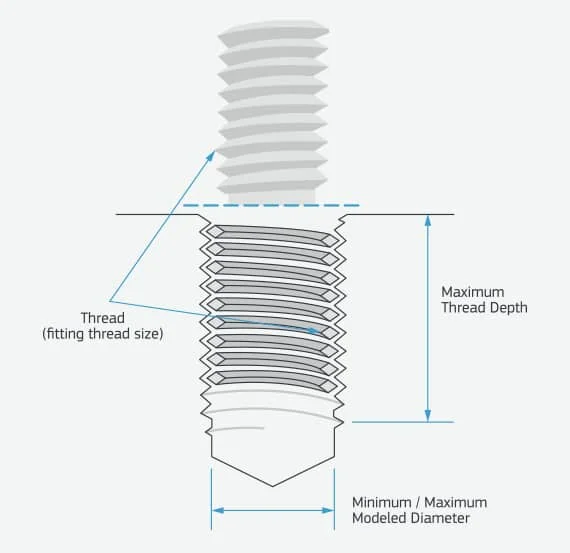
| Internal threads (tapped) | 1.5–2× nominal diameter |
| External threads (turned) | Up to 3× nominal diameter |
- For internal threads, ensure the pilot hole is correctly sized (tap drill diameter)
- Thread relief (undercut) is recommended at the end of internal threads to allow tool run‑out
- External threads should have a chamfer at the start
6. Grooves and Undercuts
Design Guidelines
| Feature | Recommendation |
|---|---|
| Groove width | ≥ 1.2 mm |
| Groove depth | Limit to 3× width to avoid tool deflection |
| Undercut radius | 0.5 mm minimum at corners |
Grooves are standard turning operations, but deep or narrow grooves may require special tooling and extend cycle time.
7. Text and Marking
If you need part numbers, descriptions, or logos on turned parts:
- Text should be raised (preferred) rather than engraved
- Minimum line width: 0.5 mm
- Minimum character spacing: 0.5 mm
- Recommended font: Sans‑Serif, 20‑point or larger
For applications requiring permanent marking without adding machining time, consider laser marking – contact our applications engineering team to discuss your requirements.
8. Surface Finish and Tolerances
Typical Surface Finish
| Surface Type | Typical Ra Value |
|---|---|
| Turned external surfaces | 0.8–1.6 µm |
| Turned internal surfaces | 1.6–3.2 µm |
| Milled features (live‑tool) | 1.6–3.2 µm |
Standard Tolerances
| Feature | Tolerance |
|---|---|
| Linear dimensions (standard) | ±0.13 mm |
| Linear dimensions (precision) | ±0.05 mm |
| Diameter (turned surfaces) | ±0.05 mm |
| Concentricity / run‑out | Per customer specification |
If you require tighter tolerances, please specify them clearly on your drawing. For more information, see our quality and inspection page.
9. Live‑Tool Capabilities
Our CNC lathes are equipped with live‑tool capability and a Y‑axis, allowing:
- Off‑centre holes – parallel or perpendicular to the Z‑axis
- Flats – machined on cylindrical surfaces
- Slots – minimum width 1.2 mm
- Radial holes – minimum diameter 2 mm
When to Use Live‑Tool Turning
- Parts requiring both turning and milling operations
- Features that would otherwise require a second setup on a milling machine
- Reduced handling and improved accuracy
10. Design Checklist for CNC Turning
| Consideration | Recommended Practice |
|---|---|
| Part shape | Rotationally symmetric |
| Wall thickness | ≥ 1.0 mm |
| Length‑to‑diameter ratio | ≤ 10:1 (for long parts, consider steady rest) |
| Axial holes | ≥ 1 mm diameter, depth ≤ 6× diameter |
| Radial holes | ≥ 2 mm diameter; parallel/perpendicular to Z‑axis |
| Threads | 1.5–2× diameter depth for internal; 3× for external |
| Grooves | ≥ 1.2 mm width; depth ≤ 3× width |
| Text | Raised; ≥ 0.5 mm line width and spacing |
| Stock | Round bar; 1–2 mm oversize |

Summary – When to Choose Turning
CNC turning is the ideal choice for parts with cylindrical symmetry. It offers:
- Superior surface finish on cylindrical features
- Lower cost for round parts compared to milling
- Efficient material usage – less waste than milling from square stock
- Single‑setup production – live‑tool lathes can complete complex parts in one operation
- Excellent concentricity – turned features are naturally coaxial
If your part can be held in a chuck and rotated, turning is almost certainly the most efficient and cost‑effective manufacturing method.
Need Help Designing for Turning?
Our applications engineering team has extensive experience in designing and manufacturing turned parts across automotive, aerospace, medical, and industrial sectors. We can help you optimise your design for cost, lead time, and quality.