

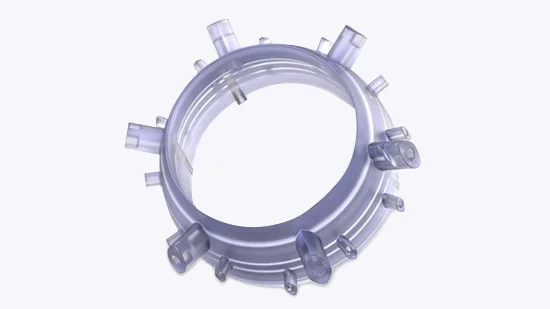

We offer many manufacturing processes and materials for prototype and production parts. But one process has a material that separates itself from the rest: optical liquid silicone rubber (OLSR) . OLSR is an advanced material that has many properties that make it a preferred material choice over polycarbonate (PC) and acrylic (PMMA) for lighting and optical parts.
At Konlida, our injection moulding services and LSR moulding capabilities support optical-grade silicone materials for demanding lighting and optical applications.
Light Transmission
Light transmission is lost as light passes through a material. PC, PMMA, and even glass will have light loss—with glass retaining up to 95%, PMMA around 93%, and PC between 88–90%. When your product requires a clear PC or PMMA part, you can improve on light transmission using OLSR, which retains up to 94% light transmission. How about the refractive index? OLSR has a low refractive index of 1.42 when compared to PC and PMMA, which are at 1.58 and 1.49 respectively.
| Property | Silicone (OLSR) | PC | PMMA | Glass |
|---|---|---|---|---|
| Light Transmission | 94% | 88–90% | 93% | 95% |
| Refractive Index | 1.42 | 1.58 | 1.49 | 1.52 |
| UV Resistance | High | Low | Medium | High |
| Chemical Resistance | High | Medium | Low | High |
| Temperature | >150°C | 120°C | 90°C | >200°C |
| Yellowing | No | Yes | Yes | No |
| Micro Detail | Yes | No | No | No |
| Thick Part | Yes >25 mm | No (limited) | Better than PC | Yes |
| Minimum Part Thickness | <0.5 mm | 1.0 mm | 1.0 mm | — |
Still another advantage is the non-yellowing factor. Thermoplastics without additives are not UV resistant, which means the parts could yellow and degrade over long exposures to lights and sunlight. OLSR is non-yellowing, so it is great for outdoor fixtures exposed to harsh environments.
For a deeper understanding of how UV resistance and other material properties affect long-term performance, see our glass transition temperature of polymers guide and materials comparison guide .
Heat and Chemical Resistance
Because OLSR is durable under temperatures that may be close to exceeding 150°C, and able to withstand many chemicals that may break down thermoplastics, you can use OLSR in high-power light fixtures, solar power, outdoor fixtures, LED lighting, cleaning fixtures, and many other environments where PC and PMMA may fail.
For applications requiring flame retardancy alongside optical clarity, the flame retardant materials and UL classifications guide provides additional context on material selection and compliance.
Injection Moulding Resilience
In plastic design, thick and thin parts are not easily achieved without sacrifice. That does not necessarily ring true with OLSR design. You can achieve thick and thin geometries that often can be as thin as 0.25 mm and as thick as 50 mm, all within the same part geometry because you do not have issues with material flow, sink, or voids.
OLSR is extremely resilient against the moulding issues that frequently create problems with thermoplastics, including the ability to create micro details. You also can design in negative draft angles without the need for expensive tooling that normally requires lifters, collapsible cores, and side-actions.
For more on design considerations for complex moulded parts, see our draft angle guidelines and designing for moldability: complex features guides.
If you are considering OLSR as an alternative to PC or PMMA, you may also find value in our material alternatives for plastic injection moulding guide, which covers substitution options for common engineering thermoplastics.
When to Use OLSR
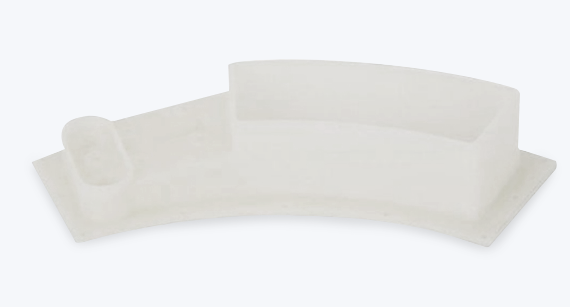
As you learn about the benefits of OLSR, the applications where you can use OLSR are numerous:
- Reducing part count in your design with built‑in gaskets
- Lenses of all types
- Light pipes or guides
- Marine and wet environments
- Outdoor and indoor light fixtures
- Low‑ and high‑heat environments
- High impact parts
For applications combining optical and sealing functions—such as lighting assemblies with integrated gaskets—our overmoulding and insert moulding design guide provides additional design considerations for multi‑material parts.
Summary
| Consideration | OLSR Advantage |
|---|---|
| Light transmission | Up to 94% — comparable to glass |
| Refractive index | 1.42 — lower than PC and PMMA |
| UV resistance | Non‑yellowing, excellent for outdoor use |
| Temperature resistance | >150°C — superior to PC and PMMA |
| Design freedom | Thick/thin sections in same part; negative draft possible |
| Minimum thickness | <0.5 mm — excellent for micro details |
Ready to Start Your Optical Silicone Moulding Project?
OLSR offers a compelling combination of optical clarity, thermal stability, and design freedom for demanding lighting and optical applications. Our applications engineering team can help you evaluate whether OLSR is the right material for your specific requirements.