

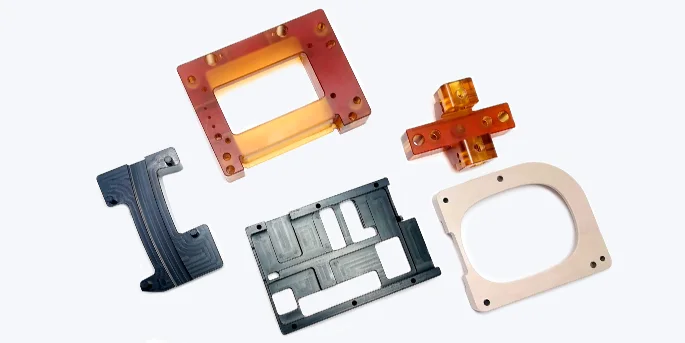

We offer two high‑temperature thermoplastics: PEEK and PEI . Both high‑performance materials can be machined and injection moulded, and produce parts that can withstand extreme temperatures.
At Konlida, our CNC machining services and injection moulding services support both PEEK and PEI, giving you flexibility in production method based on your volume and design requirements.
PEEK (Polyether Ether Ketone)
PEEK parts offer excellent mechanical and chemical resistance during high‑temperature applications. Its mechanical properties include tensile modulus strengths of 90–200 MPa and a melting temperature of 343°C . Some grades of PEEK have operating temperatures around 250°C .
Because of its robustness, PEEK is commonly used in applications for mechanical and medical instruments. PEEK is also used widely in the aerospace, automotive, and chemical industries due to its insulating properties and creep resistance—maintaining dimensional stability in high‑temperature applications.
For a deeper look at how PEEK compares to other high‑performance materials, see our using high‑performance PEEK and PEI plastics guide and materials comparison guide .
PEI (Polyetherimide)
Like PEEK, PEI (often referred to by its trade name Ultem) offers outstanding elevated thermal resistance, high strength, stiffness, and chemical resistance. PEI consists of tensile modulus strengths of 96–190 MPa and maintains performance at temperatures above 420°F .
PEI is available in transparent and opaque colours, including glass‑filled grades for improved mechanical properties. Unlike other thermoplastics, PEI provides optimal strength and resists stress cracking when exposed to hydrocarbons, alcohols, and acids—making it ideal for automotive and aerospace applications.
For parts requiring flame retardancy in addition to high‑temperature performance, see our flame retardant materials and UL classifications guide.
Which Manufacturing Process is Best?
If you are in need of small quantities (up to 200) of PEEK and PEI parts, we can machine them in less than 3 days . For increased quantities in the thousands, rapid injection moulding can produce parts with standard lead times as fast as 7 days .
The physical properties vary little between processes, so we recommend testing a sample using machining before moving to injection moulding if you are unsure whether your part design is complete.
When designing parts in PEEK or PEI, pay attention to features that could affect mouldability—such as wall thickness, draft angles, and gate placement. For guidance, see our wall thickness guidelines and draft angle guidelines .
Summary
| Material | Key Properties | Best Applications | Manufacturing Options |
|---|---|---|---|
| PEEK | Melting point 343°C; tensile modulus 90–200 MPa | Medical, aerospace, automotive, chemical | CNC machining (≤200 pcs, <3 days); Injection moulding (1,000+ pcs, ~7 days) |
| PEI (Ultem) | Service temperature >215°C; tensile modulus 96–190 MPa | Automotive, aerospace, electrical, medical | CNC machining (≤200 pcs, <3 days); Injection moulding (1,000+ pcs, ~7 days) |
Need Help with High‑Temperature Materials?
Our applications engineering team can help you determine whether PEEK, PEI, or another high‑performance material is right for your application—and which manufacturing process best suits your volume and timeline.