

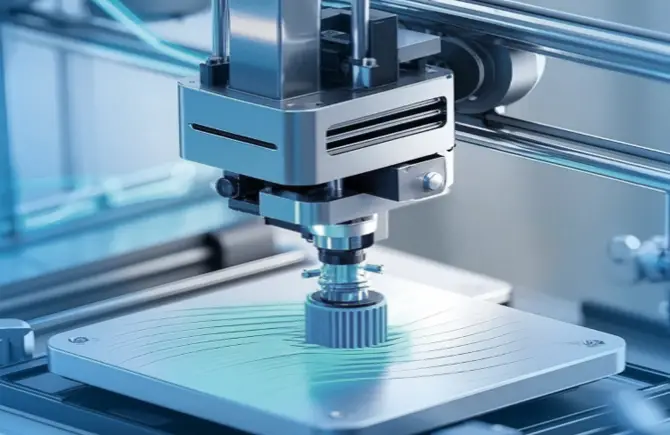

A technical comparison of properties, processing, and performance for CNC machining and DMLS
When considering lightweight, high‑strength metals for precision parts, aluminium and titanium are the top contenders. Both offer excellent corrosion resistance and good thermal tolerance. Using CNC machining or DMLS (Direct Metal Laser Sintering), these two metals have proven incredibly versatile across aerospace, medical, automotive, and consumer industries.
However, their differences in density, strength, stiffness, fatigue behaviour, cost, and processability are significant. This guide provides a data‑driven comparison to help you select the right material for your application.
For a complete material database, visit our Materials Comparison Guide.
1. Basic Physical and Mechanical Properties (Wrought / Machined Grades)
| Property | Aluminium 6061‑T651 | Aluminium 7075‑T651 | Titanium Grade 5 (Ti‑6Al‑4V) |
|---|---|---|---|
| Density (g/cm³) | 2.70 | 2.81 | 4.43 |
| Tensile strength, ultimate (MPa) | 310 | 572 | 950–1,000 |
| Tensile strength, yield (0.2%, MPa) | 276 | 503 | 880–950 |
| Elastic modulus (GPa) | 68.9 | 71.7 | 113.8 |
| Specific stiffness (E/ρ) (GPa/(g/cm³)) | 25.5 | 25.5 | 25.7 |
| Elongation at break (%) | 12–17 | 11 | 10–14 |
| Hardness | 95 HBW | 85 HBW | 35 HRC (~330 HB) |
| Fatigue endurance limit (10⁷ cycles, R=0.1, MPa) | ~95 | ~160 | ~500–600 |
| Melting range (°C) | 580–650 | 480–640 | 1600–1660 |
| Thermal conductivity (W/m·K) | 167 | 130 | 7.2 |
| Coefficient of thermal expansion (µm/m·K) | 23.6 | 23.2 | 8.6 |
Key insight: Titanium is 60–70% heavier than aluminium but has nearly three times the yield strength. However, the specific stiffness (stiffness per density) is nearly identical for both, meaning that a part designed for stiffness will weigh about the same regardless of material – but titanium will be much stronger and more fatigue resistant.
For applications requiring maximum strength‑to‑weight (e.g. aerospace structural brackets, medical implants), titanium is superior. For cost‑driven, high‑thermal‑conductivity applications, aluminium is preferred.
2. DMLS (Additive Manufacturing) Grades and Properties
Konlida offers DMLS for both metals. The alloys are optimised for powder bed fusion.
| Material | DMLS Grade | Tensile Strength (MPa) | Yield Strength (MPa) | Elongation (%) | Hardness |
|---|---|---|---|---|---|
| Titanium | Ti‑6Al‑4V (Grade 23 equivalent) | 1150–1250 | 1050–1150 | 8–12 | 38–42 HRC |
| Aluminium | AlSi10Mg | 400–460 | 240–280 | 6–10 | 45–50 HRB |
Notes on DMLS:
- DMLS titanium achieves >99.5% density and mechanical properties comparable to wrought annealed Ti‑6Al‑4V.
- DMLS aluminium (AlSi10Mg) has higher strength than die‑cast A380 but lower elongation than wrought 6061.
- Post‑processing (hot isostatic pressing, heat treatment) can improve fatigue life and close internal porosity.
Refer to our DMLS Design Guidelines for wall thickness, overhang, and support recommendations.
3. Comparative Machinability and Cost
| Parameter | Aluminium 6061 | Aluminium 7075 | Titanium Grade 5 |
|---|---|---|---|
| Machinability rating (1 = poor, 10 = excellent) | 9 | 7 | 3 |
| Typical cutting speed (m/min) – carbide tools | 300–600 | 200–400 | 30–60 |
| Tool life index (relative to 6061) | 1.0 | 0.6 | 0.05–0.1 |
| Surface finish achievable (Ra, µm) | 0.4–1.6 | 0.8–1.6 | 0.8–1.6 |
| Material cost (USD/kg, approx.) | 3–5 | 5–8 | 80–120 |
| Machined part cost (relative to 6061) | 1.0 | 1.5–2.0 | 8–15 |
Why titanium is costly to machine: Low thermal conductivity concentrates heat at the cutting edge, causing rapid tool wear. Its high strength and work hardening tendency require rigid setups, low speeds, and high‑pressure coolant. Konlida uses specialised toolpaths and carbide inserts to optimise titanium machining.
For complex geometries, consider DMLS titanium to reduce waste and machining time, though per‑part cost may still be higher than aluminium.
4. Corrosion Resistance and Biocompatibility
| Environment | Aluminium | Titanium |
|---|---|---|
| Ambient air (oxides) | Excellent (passive Al₂O₃) | Excellent (passive TiO₂) |
| Seawater / salt spray | Good (pitting possible in chloride with low pH) | Excellent (no pitting, crevice corrosion resistant) |
| Alkaline solutions (pH >9) | Poor (dissolves oxide) | Good |
| Acids (HCl, H₂SO₄) dilute | Poor | Good (resists up to moderate concentrations) |
| Body fluids / implants | Not used (corrodes, releases ions) | Excellent (biocompatible, osseointegration) |
| FDA / ISO 10993 compliance | Limited | Yes (Ti‑6Al‑4V ELI for medical) |
Practical guidance:
- Use titanium for marine, chemical, and medical implants (e.g. surgical tools, bone screws, dental implants).
- Use aluminium for general industrial, automotive, and aerospace non‑structural parts where weight and cost are primary.
5. Fatigue and Long‑Term Performance
| Property | Aluminium 6061 | Aluminium 7075 | Titanium Grade 5 |
|---|---|---|---|
| Fatigue limit (10⁷ cycles, R=0.1, smooth specimen, MPa) | 95 | 160 | 550 |
| Fatigue ratio (endurance / tensile strength) | ~0.31 | ~0.28 | ~0.55 |
| Stress corrosion cracking (SCC) resistance | Good (except high‑temp) | Susceptible in short‑transverse direction | Excellent (immune in most environments) |
| Creep resistance (at 200°C) | Low (softens) | Low | Excellent (usable up to 450°C) |
Titanium’s high fatigue strength and SCC resistance make it mandatory for rotating aircraft components, pressure vessels, and subsea equipment. Aluminium 7075 is strong but can suffer from SCC under sustained tensile stress in humid environments; proper heat treatment (T7351 over‑aging) improves resistance.
For high‑cycle fatigue applications (e.g. connecting rods, suspension parts), titanium is superior but expensive. For lower‑stressed components, aluminium is adequate.
6. Thermal and Electrical Properties
| Property | Aluminium 6061 | Titanium Grade 5 |
|---|---|---|
| Thermal conductivity (W/m·K) | 167 | 7.2 |
| Specific heat capacity (J/kg·K) | 897 | 560 |
| Electrical conductivity (% IACS) | 40–45 | 1.0 |
| Coefficient of thermal expansion (µm/m·K) | 23.6 | 8.6 |
Takeaway:
- Aluminium is an excellent heat sink and electrical conductor – ideal for LED cooling, power electronics enclosures, and battery trays.
- Titanium is a thermal barrier – used where heat must be reflected or contained, such as jet engine casings and rocket nozzles.
7. Choosing Between Aluminium and Titanium: Decision Matrix
| Criterion | Choose Aluminium | Choose Titanium |
|---|---|---|
| Cost sensitivity | ✓ | |
| Lowest weight for given stiffness | ✓ (similar specific stiffness, lower cost) | |
| Highest strength‑to‑weight | ✓ | |
| Fatigue critical | ✓ | |
| High temperature (>150°C) | ✓ | |
| High thermal conductivity | ✓ | |
| Corrosion in salt water / chemicals | ✓ | |
| Biocompatibility | ✓ | |
| Machinability / fast turnaround | ✓ | |
| Complex geometries (DMLS) | ✓ (cheaper) | ✓ (stronger but costly) |
Hybrid approach: Machined aluminium for prototypes and low‑volume production; DMLS titanium for complex, high‑performance end‑use parts where weight and strength are critical.
For case studies, visit our Application Examples [Internal Link: /case-studies/].
8. Typical Applications by Industry
| Industry | Aluminium (6061/7075) | Titanium (Ti‑6Al‑4V) |
|---|---|---|
| Aerospace | Non‑structural brackets, enclosures, heat sinks | Landing gear, engine mounts, airframe structural parts |
| Medical | Surgical tool handles (if disposable) | Implants, instruments, orthopaedic devices |
| Automotive | Suspension arms, wheels, heat exchangers | Connecting rods, exhaust valves (racing) |
| Marine | Boat hulls (5083), masts | Propeller shafts, subsea housings |
| Consumer electronics | Laptop bodies, smartphone frames | High‑end watch cases, bicycle frames |
For industry‑specific requirements, see our Industries pages.
9. Cost and Lead Time Comparison (Typical, 2026)
| Service | Aluminium 6061 | Aluminium 7075 | Titanium Grade 5 |
|---|---|---|---|
| CNC machining – prototype (1–10 pcs, per part) | €50–200 | €80–300 | €500–2000 |
| CNC machining – low volume (50–100 pcs, per part) | €20–80 | €30–120 | €200–800 |
| DMLS – small part (25 × 25 × 25 mm, one piece) | €50–100 | n/a | €150–300 |
| Lead time (machining, typical) | 3–5 days | 3–5 days | 5–10 days |
| Lead time (DMLS) | 5–7 days | n/a | 7–14 days |
Prices are indicative and depend on geometry, tolerances, and finishing.
10. Conclusion
Aluminium and titanium each have strengths. For cost‑effective, high‑thermal‑conductivity, easily machined parts, choose aluminium (6061 for versatility, 7075 for higher strength). For extreme strength‑to‑weight, fatigue resistance, corrosion resistance, and biocompatibility, choose titanium – but be prepared for significantly higher material and machining costs.
Konlida Precision Technology offers both CNC machining and DMLS for aluminium and titanium. Our application engineers can help you evaluate trade‑offs and optimise your design for manufacturability.