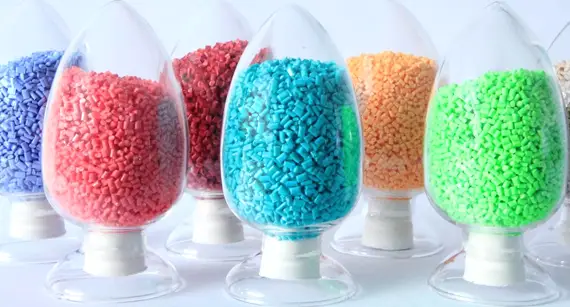
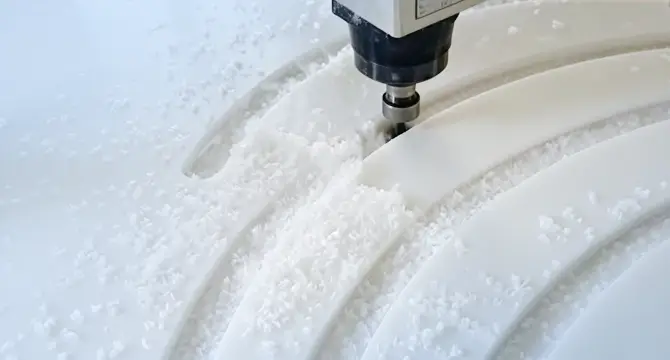
Hey! Who’s a fan of organic chemistry? crickets OK, you may not have liked studying it, but without those chains of carbon-based molecules life would be rough. Here at Konlida Precision Technology, we pay our respects to those special groups of bonded atoms called polymers. This is especially true because the plastics we use in manufacturing are all based on chains of carbon molecules, and their chemical structure affects strength, environmental interaction, appearance, and more. But this isn’t an organic chemistry course. It’s a guide to help you understand how different chains of organic molecules affect the material you choose for your parts.
Monomers: The Building Blocks of Plastics
Monomers are molecules that bond together with other molecules to form chains called polymers – rather like a chain of paperclips. This process is called polymerisation. In simple terms:
Homopolymers are chains containing long strands of a single type of monomer.
Copolymers are made up of two or more different types of bonded monomers.
Without monomers, there would be no plastics. Common monomers include ethylene, propylene, styrene, formaldehyde, phenol, acetonitrile, and ethylene glycol.
For a full list of materials we machine and mould, visit our [Internal Link: Materials Resource Center → /materials/] (green – strong).
For example, PVC (polyvinyl chloride) is a homopolymer made from vinyl chloride monomers. The copolymer Nylon 6/6 combines adipic acid and hexamethylenediamine.
Building a Copolymer
Let’s walk through how a simple molecule becomes a more complex copolymer.
Start with a basic hydrocarbon – a benzene ring (six carbon atoms in a ring, each with one hydrogen). To make styrene (a monomer), replace one hydrogen with a C₂H₃ group. To make the homopolymer polystyrene, bond many styrene molecules together.
To go from polystyrene to ABS (acrylonitrile butadiene styrene), you add monomers of acrylonitrile and butadiene to the styrene chain. Having multiple monomer types makes ABS a copolymer.
For more on ABS and other engineering plastics, see [Internal Link: Engineering Plastics Guide → /materials/plastics/engineering/] (yellow – optional).
Homopolymers vs. Copolymers: Key Differences
Let’s compare two acetal materials: the homopolymer POM-H (e.g. Delrin) and the copolymer POM-C (e.g. Celcon / Tecaform).
Characteristic
Homopolymer (POM-H)
Copolymer (POM-C)
Crystallinity level
Higher
Lower
Stiffness
✓
Tensile strength
✓
Impact resistance
✓
Creep resistance
Initially good
Better long‑term
Oxidation resistance
✓
Dimensional stability
Short‑term
Long‑term
Water resistance
✓
Temperature resistance
Higher heat distortion temperature
Endures long‑term heat better
Glass‑filled copolymers tend to be stronger and longer‑lasting than their homopolymer counterparts. Added glass fibres significantly improve mechanical properties.
For detailed material data sheets, visit [Internal Link: Material Properties Database → /materials/properties/] (green – strong).
Choosing Your Polymer
What matters most is selecting the best material for your part’s function. Understanding the basic differences between homopolymers and copolymers gives you deeper insight into which is the right choice for your application – whether you need high stiffness, long‑term creep resistance, dimensional stability, or chemical resistance.
If you are unsure which polymer to select, our application engineering team can help. [Internal Link: Contact our engineers → /contact-us/] (green – strong).
For prototyping and production, Konlida offers CNC machining, injection moulding, and 3D printing of both homopolymers and copolymers. Upload your CAD file for a free DFM analysis and quote. [Internal Link: Upload CAD for Quote → /quote/] (green – strong).