

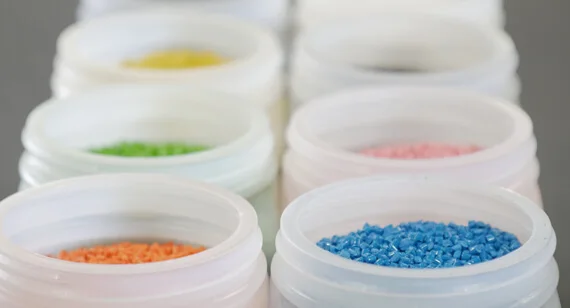

There are hundreds of plastic material options to sort through when designing for injection moulding, and it can be hard to know which one is right for your project. Our Materials Science blog series aims to simplify the decision-making process, highlighting some key materials available in each of our manufacturing processes and breaking down the benefits.
When comparing options, consider each material’s manufacturability characteristics, cosmetics, material properties, and cost to help guide your choice. Depending on your intended application, some of these characteristics will be more important than others. VALOX 357, for example, has strong chemical and flame resistant properties with exceptional processability and surface appearance.
At Konlida, our injection moulding services support a wide range of engineering-grade resins, including VALOX and other high-performance materials for demanding applications.
VALOX 357 Properties and Ideal Applications
VALOX 357 is a non-reinforced, impact modified, injection mouldable grade resin. The Polycarbonate/Polybutylene Terephthalate (PC/PBT) blend is highly flame retardant with good temperature performance and a relative temperature index of ‑40°C to 140°C. It also has high mechanical, thermal, and electrical properties; dimensional stability; and very good processability, making it a versatile general purpose resin that is an exceptional candidate for a wide variety of applications including bobbins, switches, and enclosures.
The VALOX family of resins are resistant to a variety of chemicals, including hydrocarbons, dilute acids and bases, detergents, and aqueous salt solutions. This strong chemical resistance and its dimensional stability make VALOX 357 a great option for applications ranging from automotive to electronic to medical uses. Common applications include parts for under‑the‑hood automotive, oil and gas, construction, outdoor (including lawn and garden equipment), fluid handling, electronic displays, lighting, appliances, household goods, and healthcare. In its natural state, VALOX 357 PBT is opaque in appearance.
For applications requiring flame retardancy, the flame retardant materials and UL classifications guide provides additional context on how materials like VALOX achieve their UL ratings and what those ratings mean for real‑world performance.
When selecting a material for parts that must withstand chemical exposure—such as automotive under‑hood components or industrial fluid handling systems—understanding the relationship between polymer structure and chemical resistance is essential. The glass transition temperature of polymers guide explains how thermal transitions affect a material’s ability to resist chemical attack and maintain dimensional stability across varying temperatures.
VALOX 357’s combination of chemical resistance and dimensional stability makes it particularly well suited for parts that require tight tolerances in demanding environments. For more on how material selection impacts part cost and tooling decisions, see our understanding injection mould cost for parts and tooling guide.
VALOX 357 Specifications
When designing a part intended for VALOX 357 moulding, you are likely looking for additional material specifications including hardness rating, tensile strength, and impact resistance. Key properties include:
| Property | Value |
|---|---|
| Hardness (Rockwell R‑Scale) | 117 |
| Water absorption (24 hours) | 0.080% |
| Outdoor suitability (UL 746C) | f2 |
| Tensile strength at break (ASTM D638) | 42 MPa |
| Tensile strength at break (ISO 527‑2/50) | 40 MPa |
| Tensile elongation at break (ASTM D638) | 54% |
| Tensile elongation at break (ISO 527‑2/50) | 30% |
Unlike VALOX 420SEO, VALOX 357 is not reinforced. If you are looking for a glass fibre reinforced Polybutylene Terephthalate with the same material properties and applications offered with VALOX 357, VALOX 420SEO is a good solution—it is a 30% glass‑filled resin with many automotive, electrical, and aerospace applications. Both have high flow in thin sections, offering excellent surface finish.
For a complete overview of available materials and their properties, see our materials comparison guide . If you are exploring alternative materials due to supply chain considerations, our material alternatives for plastic injection moulding guide offers practical substitution options.
VALOX in Overmoulding Applications
VALOX Polybutylene Terephthalates form a strong chemical bond with TPU and TPC thermoplastics, making them excellent substrate options for overmoulding and insert moulding applications.
A strong material bond is critical to overmoulding success. When designing overmoulded parts with a VALOX substrate and a soft elastomer overmould, consider the following:
- Chemical bonding – VALOX forms a strong chemical bond with TPU and TPC, eliminating the need for mechanical interlocks in many applications
- Processing temperatures – Ensure the overmould material’s processing temperature is compatible with VALOX’s heat deflection characteristics
- Part geometry – Design features that allow proper flow of the overmould material without compromising the substrate
For more on LSR and other thermoset overmoulding considerations, see our LSR moulding guide .