

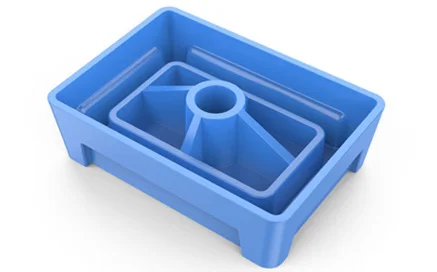

Apply proper draft early and often to injection‑moulded parts to save production time and money
When developing parts for plastic injection moulding, applying draft (or a taper) to the faces of the part is critical to improving the mouldability of your part. Without it, parts run the risk of poor cosmetic finishes, and may bend, break, or warp due to moulding stresses caused by the plastic cooling. Equally important, an absence of draft may prevent parts from ejecting from the mould, damaging not only the parts, but possibly the mould itself—a costly and time‑consuming detour.
What is draft in injection moulding?
Draft is a taper applied to the faces of the part that prevents them from being parallel to the motion of the mould opening. This keeps the part from being damaged due to scraping as the part is ejected out of the mould.
Here are five ways that draft can improve part mouldability:
- Reduces friction during ejection
- Prevents cosmetic defects (scratches, drag marks)
- Minimises warping and distortion
- Extends mould life
- Enables faster cycle time
Incorporate Draft into Early Prototypes
Ignoring draft early in the design process is a common mistake that occurs when prototyping with 3D printing or CNC machining processes where draft is not required. Because of the layer‑by‑layer method in which 3D‑printed parts are built, nearly any design can be produced with limited concern for mouldability. The same can be said for machined parts, as part ejection is purely a moulding consideration.
But if a prototype design will eventually move to injection moulding, it is essential to design draft into parts from the very beginning. Draft may alter the form and fit of a part during assembly and its overall aesthetic, so designing in draft, even when it’s not technically needed, can help you avoid costly redesigns and additional prototype development.
Design for the future need, not the current need. When the part is ready to move from 3D printing or machining into injection moulding with draft already integrated, design is accelerated and production can begin sooner.
🔗 内链:Design for Manufacturing Toolkit → /resources/design-for-machining-toolkit/ (green – strong)
Basic Guidelines for Draft on Injection‑Moulded Parts
No single draft angle can be applied to all part designs. Factors like wall thickness, material selection, ejection, shrink rates, finish/texture, wall depth, and manufacturing capabilities all come into play.
General rule of thumb: Apply as much draft angle as possible—approximately 1 degree of draft per 25 mm of cavity depth, but this can change with the factors mentioned above.
Recommended Draft Angles
| Requirement | Recommended Draft |
|---|---|
| All vertical faces | 0.5° minimum (strongly advised) |
| Most situations | 1–2° (works very well) |
| Shutoff (metal sliding on metal) | 3° minimum |
| Light texture (PM‑T1) | 3° minimum |
| Heavy texture (PM‑T2) | 5°+ required |
Feature Depth vs. Minimum Thickness / Draft
| Feature Depth | Option 1 | Option 2 | Option 3 |
|---|---|---|---|
| 6.35 mm | 1.02 mm / 0.5° | — | — |
| 12.70 mm | 1.02 mm / 1° | 1.52 mm / 0.5° | — |
| 19.05 mm | 1.02 mm / 2° | 1.52 mm / 1° | 2.03 mm / 0.5° |
| 25.40 mm | — | 1.52 mm / 2° | 2.03 mm / 1° |
| 38.10 mm | — | — | 2.03 mm / 2° |
| 50.80 mm | — | — | >2.54 mm / 2° |
What if draft negatively impacts part performance? Parts can be designed with 0.5 degrees of draft, or even as little as 0.25 degrees, which is still an improvement over zero draft. The smallest feasible draft depends on material, part geometry, and manufacturer—discuss this with our applications engineering team before finalising a part with very limited draft.
Low‑volume aluminium tooling: Many low‑volume injection tools are manufactured from aluminium and use CNC machining to mill nearly all features. With fewer manufactured parts and inserts than a steel production mould, additional draft and wall thickness may be required. This typically does not affect part performance and may actually improve the performance of the eventual production mould.
🔗 :Materials Comparison Guide
🔗 :Contact our applications engineering team
Implement a Core‑Cavity Approach
Adding draft to an enclosure can create issues if it isn’t applied correctly. When applying draft to inside and outside walls, design these walls parallel to each other to avoid deep ribs in the mould that make venting, ejection, mould finishing, and manufacturing more difficult.
Consider a core‑cavity approach to design—this opens up the mould cavity and core for polishing, accelerates manufacturing speed and, in general, brings added ease during the moulding process.
Leverage Free DFM Analysis
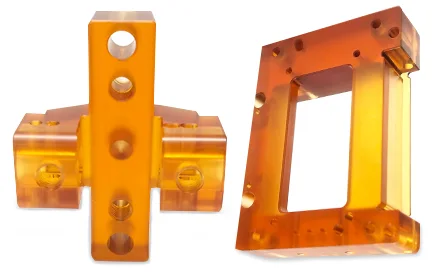
One of the most valuable tools available at Konlida is our free design for manufacturability (DFM) analysis, provided on every 3D CAD model uploaded to our platform. Within a few hours, you will receive a quote that highlights detailed sections of the model in need of draft angles, and even offers suggested changes to improve draft on those sections. It’s a good quality control check to help avoid future mouldability issues.
🔗 内链:Upload CAD for a free DFM analysis and quote → /get-instant-quote/ (green – strong)
[Image: Undrafted wall with proper tool clearance (left), undrafted tall wall without clearance (middle), drafted wall with adequate clearance for the end mill (right)]
Factor in Surface Finish
How does draft affect part finish? Simply put, without mould draft, the part would drag on the moulded surface while the mould opens and ejects the parts, creating surface finish scratches. Since all thermoplastics shrink while cooling in the mould, a massive amount of surface tension is created, preventing the part from releasing cleanly during ejection. This tension creates small scratches on polished surfaces—and it’s even worse for textured surfaces if draft is missing.
Texture is applied in many different ways, but all create micro‑undercuts from pitting the mould surface. The texture on mould walls would lock the part into place, if it weren’t for draft. By applying a degree of draft, the part is allowed to move a short distance before the mould shrink clears the micro‑undercuts, minimising mould drag and scratches on the part.
Surface finish draft requirements:
| Finish Type | Minimum Draft Required |
|---|---|
| PM‑T1 (Light bead blast) | 3° |
| PM‑T2 (Medium bead blast) | 5° |
Konlida can apply seven different finishes to thermoplastic moulds, ranging from unfinished to highly polished and textured surfaces.
Summary
Proper draft is essential for successful injection moulding. It reduces defects, extends tool life, and ensures reliable part ejection. By following these guidelines—adequate draft angles, consistent wall thickness, and thoughtful geometry—you can produce higher quality parts with greater consistency.
| Key Takeaway | Recommendation |
|---|---|
| Minimum draft on vertical faces | 0.5° |
| Recommended draft for most parts | 1–2° |
| Draft for light texture (PM‑T1) | 3° |
| Draft for heavy texture (PM‑T2) | 5°+ |
| Draft for shutoff surfaces | 3° |
| General rule | 1° per 25 mm of cavity depth |